
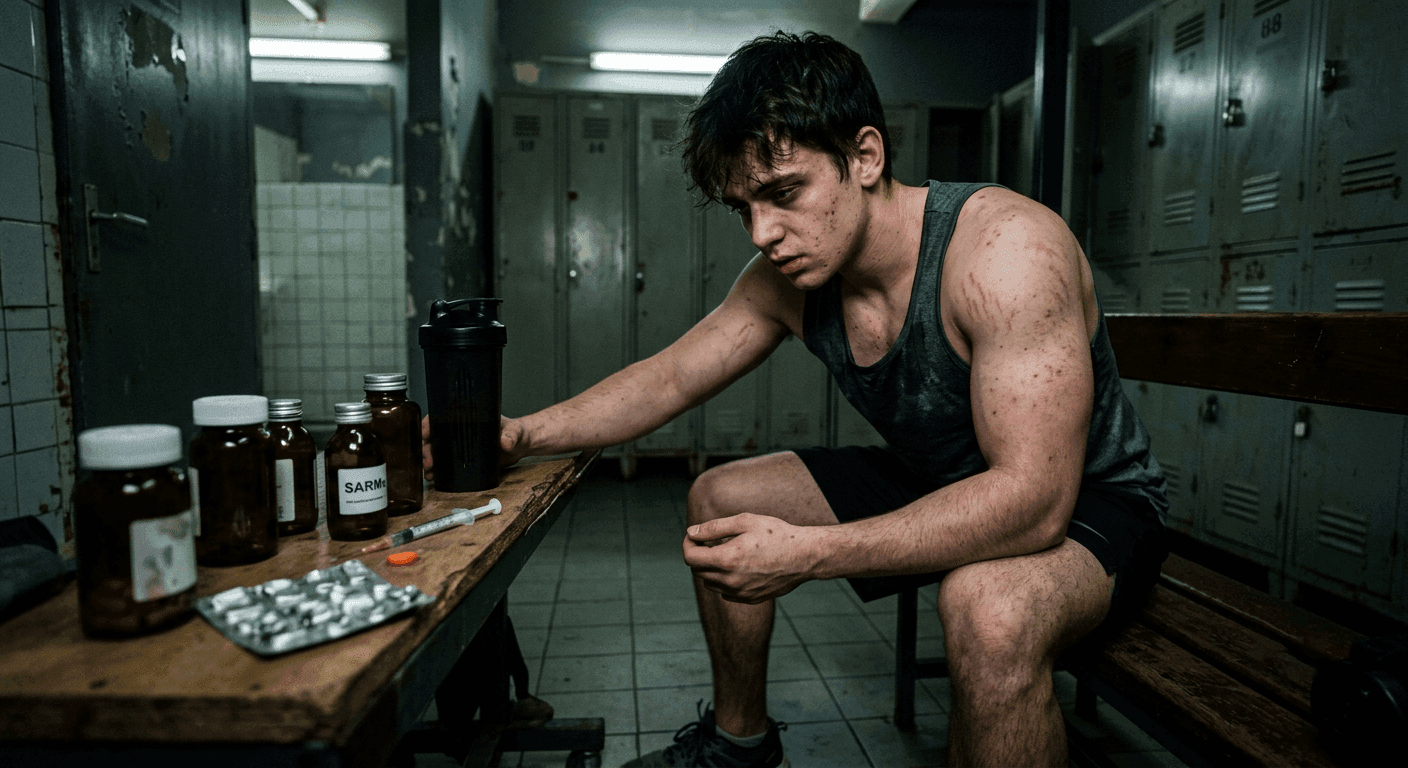
There's a steroid epidemic happening in plain sight, and it's getting younger. Boys as young as 15 are now experimenting with anabolic steroids and SARMs (selective androgen receptor modulators), convinced that a needle or a capsule is the missing piece between who they are and who they think they're supposed to be. It's one of the most under-discussed health problems facing young men today.
An Epidemic Hiding in Plain Sight
Anabolic steroid use among teenagers isn't new, but the scale and the age of it are. What used to be the domain of competitive bodybuilders has trickled down to high-school kids who have never stepped on a stage. SARMs in particular — often falsely marketed as a "safe," milder alternative — have made it easier than ever for a 15- or 16-year-old to start tampering with his hormones, frequently with products bought online that aren't even what the label claims.
Access is a huge part of the problem. A sprawling grey market for steroids, peptides, and SARMs operates almost in the open — moved through fly-by-night websites, social-media DMs, and "research chemical" shops that hide behind a not-for-human-consumption label. It's cheap, it ships discreetly, and it rarely draws serious enforcement: authorities tend to focus on large-scale traffickers, which leaves a teenager with a debit card able to order hormone-altering compounds about as easily as a pair of shoes. With almost no gatekeeping and even less quality control, what shows up is often underdosed, contaminated, or a completely different compound than the label promises.
Raised on Unrealistic Bodies and Fake Natties
Why now? Because this generation of boys is the first to grow up marinating in a 24/7 feed of unrealistic physiques. Every scroll serves up another shredded, vascular, larger-than-life body — and a huge share of them belong to "fake natties": influencers who use steroids while claiming, or strongly implying, that they're completely natural.
This is where the real damage starts. When enhanced bodies are passed off as drug-free, they quietly reset what a teenager believes is naturally achievable. He compares his normal, still-developing frame to a chemically-built one he thinks is natural, concludes he's failing, and never realises the comparison was rigged from the start. Body image gets distorted, then distorted again, until "normal" starts to look like "not enough."
Low Self-Esteem Is the Real Target
Steroids aren't really sold to teenagers as muscle — they're sold as a fix for how they feel about themselves. Kids with low self-esteem are the easiest mark: tell a boy who feels invisible, small, or disrespected that testosterone and SARMs are the shortcut to size, confidence, and social presence, and you've handed him an escape from the thing that actually hurts. He isn't chasing biceps; he's chasing respect and the feeling of being enough.
The tragedy is what he trades for it. Convinced these drugs are necessary to be taken seriously, he starts dismantling a hormonal system that was working perfectly — and ends up, completely unnecessarily, with the opposite of what he wanted: messed-up hormones and worse mental health. The insecurity that drove him there doesn't lift; it deepens, now with real physiological and psychological consequences bolted on.
What These Drugs Do to a Developing Body and Mind
At 15, 16, or 17, the body is in the most anabolic, sensitive window of its life — natural testosterone surging, growth plates possibly still open, the brain-to-testes hormonal axis still calibrating. Dropping powerful exogenous hormones into that system doesn't enhance it; it overrides it. The body responds by shutting down its own testosterone production, and for those who start young or cycle repeatedly, that system may never fully switch back on.
Without offering anything that reads as a how-to, the documented risks in young users include stunted final height from premature growth-plate closure, cardiovascular strain and an enlarged heart, dangerous cholesterol shifts, liver stress, gynecomastia, testicular atrophy, and infertility — and, on the mental side, aggression, anxiety, and severe depression, especially during the crash after a cycle ends. The hormonal damage and the mental-health damage feed each other.
The People Who Sold the Dream — and Paid for It
This isn't theoretical, and some of the biggest names in the culture are the clearest warnings. Zyzz (Aziz Shavershian), the figure who arguably launched modern online "aesthetics" culture, collapsed and died in a sauna in 2011 at just 22. He had an undiagnosed congenital heart defect, and the combination of that condition with steroid use and a hard partying, raving lifestyle is widely believed to be what killed him. Rich Piana built an entire brand on being larger than life and was openly candid about the enormous steroid cycles he ran for most of his career; he died in 2017 at 46, with an enlarged heart and years of documented health problems part of the picture. Dallas McCarver, a 26-year-old pro widely seen as the future of bodybuilding, was found unresponsive in 2017 — his autopsy revealed an enlarged heart that years of heavy use and extreme training likely worsened.
These are three names on a much longer list. The pattern repeats so often it has a grim familiarity to it: the larger-than-life lifestyle that looks so aspirational online keeps cutting lives short. These weren't careless rookies — they were the people selling the dream, and the dream still came for them.
Where Testosterone Therapy Actually Belongs
None of this makes testosterone itself the enemy. There's a real, legitimate, evidence-based use for it — and it's almost the opposite of the teenage scenario. Testosterone Replacement Therapy (TRT) exists for men with a genuine clinical deficiency: diagnosed hypogonadism, or a meaningful decline in older men whose levels have genuinely fallen, paired with real symptoms like persistent fatigue, low libido, lost muscle and bone density, and low mood.
The difference is diagnosis and supervision, not the molecule. Proper TRT means a physician, low bloodwork confirmed more than once, a real symptom picture, and ongoing monitoring of hormones, red blood cell count, prostate, and cardiovascular health — with the goal of restoring a deficient man to a normal range, not pushing a healthy one beyond it. An older man with clinically low testosterone, treated and monitored by a doctor, is doing something completely different from a 16-year-old dismantling a perfectly healthy system. If that older man is you, the answer isn't a website or a gym contact — it's a conversation with a qualified physician and proper lab work.
For 90% of People, It's a Mistake
Here's the honest bottom line: for the small minority with a real, diagnosed deficiency, testosterone therapy can be genuinely life-changing. For the other ~90% — and for essentially every healthy teenager — reaching for steroids, SARMs, or testosterone is a mistake. It trades a working body and a shot at real, earned confidence for a long-term medical problem and, far too often, worse mental health than they started with.
There is a narrow exception, and it's worth being honest about it. A tiny number of people — the genuinely genetically gifted and obsessively driven — choose to make a career out of competitive bodybuilding, where enhancement is effectively part of the sport. Even then, the only remotely defensible version happens under extreme supervision: a doctor monitoring bloodwork and heart health constantly, and a dietician engineering every meal. But that path demands a level of single-minded drive, sacrifice, and risk tolerance that the overwhelming majority of people simply do not have and will never develop. For everyone outside that rare slice — which is to say almost everyone reading this — it stays a mistake.
If you're young, your body is already producing more of the most powerful muscle-building hormone you will ever have — for free. The fundamentals (progressive overload, enough protein, real sleep, and years of consistent work) build a genuinely impressive physique with none of the irreversible downside. Use CrossTrainer to track your training, nutrition, and progress over time, and let the results prove what natural, patient work can do. The respect you're really after was never going to come from a needle.
If You Use Anyway, Don't Skip Bloodwork or Your Diet
If, despite all of this, someone is going to use, the bare minimum is to take the risks seriously. That means regular, comprehensive bloodwork — tracking hormones, red blood cell count and haematocrit, cholesterol and lipids, liver and kidney markers, and cardiovascular health before, during, and after — so problems are caught early instead of discovered too late. It also means a genuinely clean diet: whole foods, healthy fats, plenty of fibre, controlled sodium, and the cardio to match, because compounds that strain the heart and skew cholesterol are far more dangerous stacked on top of junk food and a sedentary lifestyle. None of this makes anabolic use "safe" — it only blunts some of the risk, and it's no substitute for a doctor's supervision. But flying blind, with no labs and a dirty diet, is how the worst outcomes happen.
This article is for education and awareness only and is not medical advice. If you have concerns about hormones, body image, or anabolic substance use, please speak with a qualified healthcare professional.